Representative Government:
Prelude to Armageddon
Few blogs address politics from a theological perspective in a nation that ostensibly values the separation of Church and State.
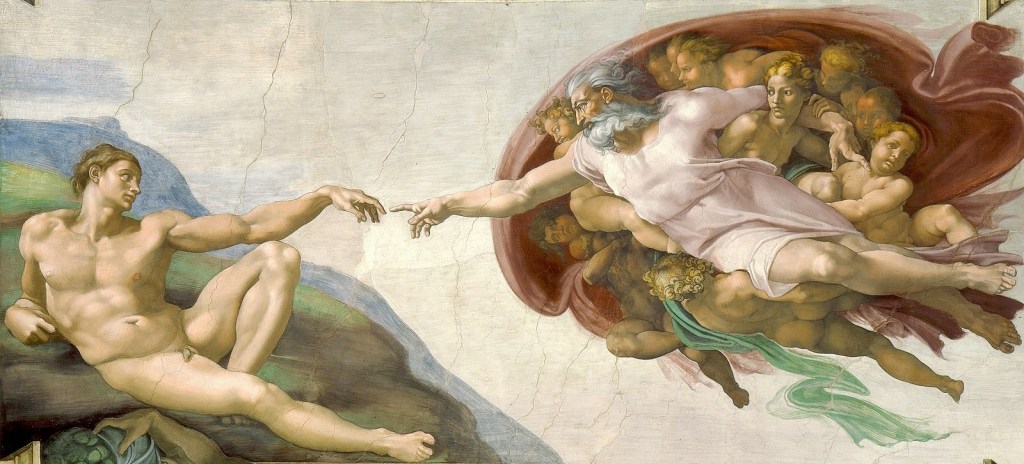
My understanding of Genesis has, of course, been influenced by the formative Catechism classes of my Roman Catholic upbringing. My memory of the ceiling of the Sistine Chapel as a graphic novel version of the Bible remains powerful. As a child, I was impressed with Michelangelo’s artistry. As a teenager, I was somewhat shocked by his depiction of Adam as completely naked. As I encountered the theological implications of Renaissance art, I was impressed by his depiction of not just Adam’s penis but by the anatomical correctness in painting his navel. The tangible aspect of an umbilical cord on someone who was fashioned from clay by God forced many artists of the day to obscure the entire midsection of Adam. And, of course, Eve was not born either.
As an adult visiting the Vatican, I looked up—far above me—to see that Voltaire’s cynical comment was dramatically correct: “God created man in His own image, and man returned the compliment.” As an older man of European descent with grey hair and a beard, I could understand this choice of portraying the Ancient of Days. But my theological dislike for an anthropomorphic deity remains steadfast. My metaphysical concept of the unknowable essence of the universe is greatly diminished by any physical representation, even One Who looks somewhat like me. (My beard is neatly trimmed …)
However, after an election where the Christian Nationalist vote appears to have been substantial, a blog post that begins with references to Genesis seems relevant and timely.
In our modern age, the most popular religion in the United States is None of the Above (47%). However, if we include SBNR folks (Spiritual but not Religious), then approximately 80% of people believe in spiritual values — some conception of right and wrong.
If we aggregate denominations and sects into the broad categories of Abrahamic religions (Judaism, Christianity, Islam, Bahá’í Faith), we have Christianity as the predominant form of organized worship of God in the United States. And, given their universally shared acknowledgment of Genesis as Scripture, nearly everyone accepts the theological framework that the loss of the Garden of Eden’s innocence is the result of intervention by an external entity: the Serpent, Adversary, or Satan …
Thus, when we use the adjective satanic, we invoke the primal origin of evil corrupting the world.
Satanic:
adjective. of Satan. characteristic of or befitting Satan; extremely wicked; devillike; diabolical. Synonyms: infernal, fiendish, hellish, devilish, evil.

1.	of or relating to Satanism, a highly diverse group of religious, philosophical, or countercultural practices centered around Satan.
Overlap of the Secular and the Ecclesiastical
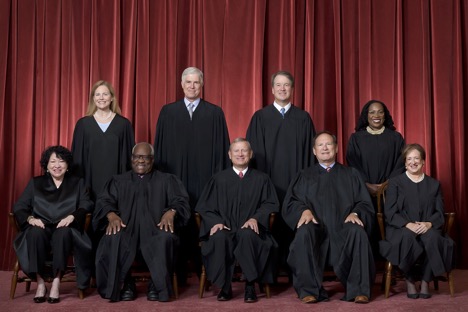
Although the current Pope, Francis, does not define abortion as satanic, the six Supreme Court Justices whose religious affiliation is with the Roman Catholic Church may have adopted that view in their over-rule of Roe v. Wade. That would certainly match the view of Father Ganley and the nuns of my Catechism classes.
Going back to Ronald Reagan’s halcyon days, as the influence of orthodox Christianity began to fade, replaced by faith in secular sovereigns, the sacraments of the church were displaced by the sacraments of the state. And by the dogma of The Heritage Foundation®.
In a capitalist system, the invisible hand of the market, not the unseen hand of God, guides us to higher levels of prosperity. Selfishness becomes sanctified. Free enterprise competition will automatically create a level playing field for all, the argument goes.
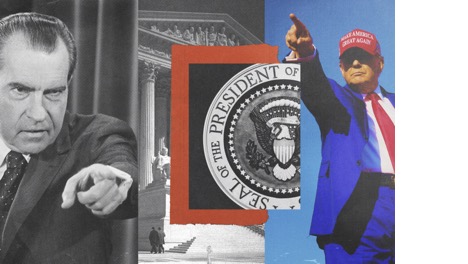
Now, belief in Scripture and secular democratic institutions has been replaced by devotion to authoritarian leaders who sanction faux nostalgia and limitless greed. In Donald Trump’s ascendency, we appear to be witnessing the emergence of a new secular faith: RBNM (Religious but not Moral).
- Are institutions, both secular and ecclesiastical, an aid to the development of civilization?
- Or are they an impediment to unbridled capitalism?
- Does the government that governs least govern best?
- Should we revert to anarchy or cling to the benevolent rule of a despot?
Before The Deluge
From the PBS News Hour on November 1, 2024
In discussing norms of political behavior, David Brooks of the New York Times veered into the world of religion:
•	Amna Nawaz:
David, you mentioned it's Donald Trump who's upended a lot of these norms. Does it change if he loses?

•	David Brooks:
I don't know.
I was at a church in Tennessee. I decided it'd be interesting to go to a Christian nationalist church. And so I went to this. And I have to say the congregation was sincere in its faith. Sometimes, you think Christian nationalism is all about politics. These people were clearly moved by their faith.
But the pastor up there in the pulpit is calling Kamala Harris satanic. There's crudity. It's just like I was at that church. I thought, Donald Trump fit into something. And it wasn't only professional wrestling. It was in churches. It was preexisting in the churches and the neighborhoods.
And it was just this culture of the narcissistic cult leader. And I saw it at the church, and I think Trump is a version of that. So I don't know if we go — like, if Trump exits the scene, I'm not sure we go back there. We have got the professional wrestle-ization of American society that's out there.
Brooks and Capehart went on to define Trump as the apotheosis of toxic masculinity and the effective evocation of racism.
Before the election, many people saw the Democrat-Republican divide as different concepts of how the process of governance works — fundamental questions that the Founding Fathers wrestled with.
In a New York Times Opinion piece — just before the election:
EZRA KLEIN
There’s Something Very Different About Harris vs. Trump
Nov. 3, 2024
…
But there’s another axis that politics can polarize along: the basic worth of institutions. To Democrats, the institutions that govern American life, though flawed and sometimes captured by moneyed interests, are fundamentally trustworthy. They are repositories of knowledge and expertise, staffed by people who do the best work they can, and they need to be protected and preserved.
The Trumpist coalition sees something quite different: an archipelago of interconnected strongholds of leftist power that stretch from the government to the universities to the media and, increasingly, big business and even the military. This network is sometimes called the Cathedral and sometimes called the Regime; Trump refers to part of it as the Deep State, Vivek Ramaswamy calls the corporate side “Woke Inc.” and JD Vance has described it as a grave threat to democracy.
After The Deluge
A Sad Watch Party at My Home
On the evening of November 5th, as I awaited the American people’s decision (and the subsequent machinations of Trump’s lawyers), the choice seemed stark, but the verdict remained unclear.
As the results came in, How, I asked, could the polls have been so wrong?
My suspicion:
I suspect that the polling institutions are often seen as part of the regime of the elites, an extension of the Deep State. Consequently, in response to texts, emails, or calls, candor is viewed as unwise:
Polling dialogue:
	Ring, ring … ring.
Bubba:
“Howdy.  Who’s callin’?”
Louie:
“This is Louis Gzoninplatz from The New Woke Times.”
“I’m calling to ask who youse gonna vote for?”
Bubba:
“Well …	 I’m fixin’ to make up my mind.”
“I might could call you back when I figure it out.”
-click

Louie:
To co-worker: “Huh, another undecided.”
The New York Times
Attempts to Console the Defeated
In the aftermath, the postmortem analysis began quickly.
David Brooks eloquently described class warfare and its education-based foundation.
Ezra Klein suggested that the Democrat’s calamitous loss should be a catalyst for real listening …
But, along with David Brooks, I fear that the effective demonizing of Kamala Harris by Donald Trump resonates with a powerful swath of “We the People.” Both secular and ecclesiastical.
Absence of Norms
In the last decade, we have lost not only the “formal guardrails” (legal and customary behaviors) that regulate society but also aspects of enlightened traditions (e.g., queuing in England…) that enable courteous and dignified civilizations to flourish.
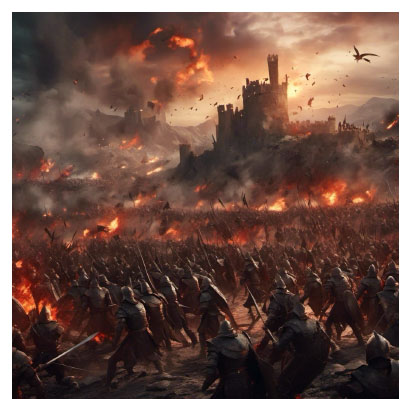
What Joe Biden referred to as a “Battle for the soul of America” appears to have the potential to become a mirror of the havoc in Ukraine, Gaza, and Lebanon.
A Goal with Alternate Paths
In 1985, the Universal House of Justice of the Bahá’í Faith addressed a message to the peoples of the world, inviting them to consider that a new social order can be fostered by all people seeing themselves as members of one universal family. This message was presented to world leaders and countless others during the United Nations International Year of Peace.
The Great Peace towards which people of good will throughout the centuries have inclined their hearts, of which seers and poets for countless generations have expressed their vision, and for which from age to age the sacred scriptures of mankind have constantly held the promise, is now at long last within the reach of the nations. For the first time in history it is possible for everyone to view the entire planet, with all its myriad diversified peoples, in one perspective. World peace is not only possible but inevitable. It is the next stage in the evolution of this planet—in the words of one great thinker, “the planetization of mankind”.
Whether peace is to be reached only after unimaginable horrors precipitated by humanity’s stubborn clinging to old patterns of behaviour, or is to be embraced now by an act of consultative will, is the choice before all who inhabit the earth. At this critical juncture when the intractable problems confronting nations have been fused into one common concern for the whole world, failure to stem the tide of conflict and disorder would be unconscionably irresponsible.
It is encouraging that a significant source of ecclesiastical insight proclaims the achievability of our vital aspirations for an age-old vision. However, the institution’s clear warning of “unimaginable horrors precipitated by humanity’s stubborn clinging to old patterns of behavior” is — for me — terrifying.
In the wake of World War I, William Butler Yeats perceived a prescient, darker poetic view of our collective apocalyptic trajectory. The lines from the end of the first stanza are often quoted:
The best lack all conviction, while the worst
Are full of passionate intensity.
The passionate intensity of fanatics and demagogues, both secular and ecclesiastical, has been a siren song for more than a century.
The Second Coming  (1919)

BY WILLIAM BUTLER YEATS

Turning and turning in the widening gyre
The falcon cannot hear the falconer;
Things fall apart; the centre cannot hold;
Mere anarchy is loosed upon the world,
The blood-dimmed tide is loosed, and everywhere
The ceremony of innocence is drowned;
The best lack all conviction, while the worst
Are full of passionate intensity.

Surely some revelation is at hand;
Surely the Second Coming is at hand.
The Second Coming! Hardly are those words out
When a vast image out of Spiritus Mundi
Troubles my sight: somewhere in sands of the desert
A shape with lion body and the head of a man,
A gaze blank and pitiless as the sun,
Is moving its slow thighs, while all about it
Reel shadows of the indignant desert birds.
The darkness drops again; but now I know
That twenty centuries of stony sleep
Were vexed to nightmare by a rocking cradle,
And what rough beast, its hour come round at last,
Slouches towards Bethlehem to be born?
May we eventually recognize — in ourselves and in each other — some flicker of the positive, creative energies of the universe. May that vision, that we are all designed in the image of the primal point of creation, hasten the advent of great peace and goodwill toward all citizens of this fragile planet.


 Best of Times, Worst of Times